
Exploring Southeast Asia’s Resort Investment Hotspots
In 2023, Asia Pacific’s hotel industry will likely attract $10.1 billion in investment volumes, according to JLL’s recently published Hotel Investment Highlights H2 report. Looking deeper, the analysis also shows a growing interest among investors in resort destinations. As a percentage, over 11% of total investments are presented by resorts at the end of 2021, up from 6% in 2016. As investment interest is expected to grow exponentially in the coming years, a more detailed analysis of resort destinations in Southeast Asia, specifically in more active resort destinations such as Bali, Danang, Koh Samui, the Maldives and Phuket, will be demanded by investors during the due diligence and decision-making process.
Key Resort Investment Trends
10-Year Resort Investment Volume
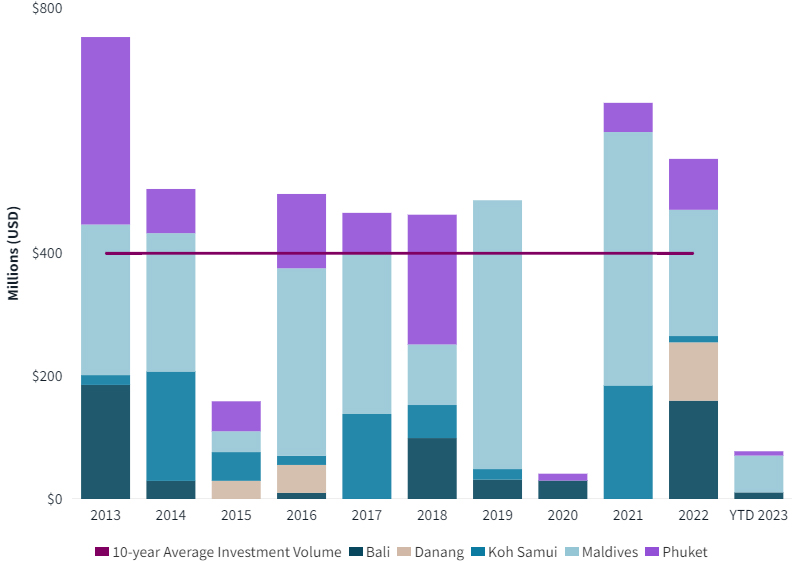

Over the last decade, USD 4.6 billion in capital have been invested in Southeast Asia resorts, representing an average total volume of USD 457 million annually.
BALI
As a foreign investor, we advise clients to utilize a foreign-owned company (PT PMA) and obtain a ‘Right to Build’ (Hak Guna Bangunan) certificate, which grants an initial 30-year period of ownership, extendable by 20 years, and a subsequent 30-year renewal opportunity. Consequently, the total duration of ownership amounts to 80 years, akin to freehold status, despite being labelled as “leasehold,” ensuring the capability for renewable ownership.
Investment Volumes
In the past decade, Bali has attracted a total investment volume of USD 557 million, representing 12% of the total Southeast Asia resort market.
This cumulative investment volume surpasses the 10-year average by approximately 1.2 times, with nearly 2,400 keys transacted.
Notable transactions
The 100-key Anantara Ubud Bali Resort transacted at USD 41.4 million in 2016 through a joint venture between Minor Hotels and PT Wijaya Karya Realty.
The 415-key Sofitel Nusa Dua transacted at USD160 million in 2022 to ST International, a South Korean buyer.
DANANG
In Vietnam, foreign investors have the opportunity to invest in hotels with up to 100% ownership. This can be achieved by acquiring Land Use Rights through a land lease with a maximum term of 50 years.
Investment Volumes
In the past decade, Danang has recorded a total transaction volume of USD 170 million, representing a 4% share of the total Southeast Asia Resort market.
Transactions include the sale of 1,035 keys, which amounts to only 37% of the total 10-year average.
Notable transactions
The 100-key The Nam Hai Hoi An, (now Four Seasons Resort The Nam Hai, Hoi An) transacted at USD 65 million in 2016 by JLL.
The 374-key Hyatt Regency Danang Resort and Spa sold in 2022 to Crescent Group.
KOH SAMUI & PHUKET
Foreign ownership is possible in both Koh Samui and Phuket through approval by the Board of Investment (BOI) for newly built properties. However, specific requirements must be met, such as having more than 100 keys and a minimum investment of THB 500 million for newly constructed properties.
Investment Volumes
In the past decade, Koh Samui has recorded a total transaction volume of USD 657 million, capturing a 14% market share with more than 2,800 keys transacted.
Phuket has recorded a total transaction volume of USD 974 million, representing a notable 21% market share with close to 4,400 keys transacted.
Notable transactions
In Koh Samui, the 138-key Choengmon Beachfront Resort (now Kimpton Kitalay Samui) transacted at USD74 million by JLL in 2021.
In Phuket, the 257-key Westin Siray Bay Resort and Spa (to be rebranded as The Ritz-Carlton Phuket in 2025) transacted at USD 71 million in 2022 and the 77-key Anantara Phuket Layan Resort & Spa transacted at USD 10.4 million in 2021 where JLL provided buy-side advisory services.
MALDIVES
Investor-friendly characteristics significantly contribute to the appeal of investing in the Maldives. This includes 100% foreign ownership of leasehold rights over resorts, a US dollar-denominated market, and the possibility of long leases for land up to 99 years. For more comprehensive information on investing in the Maldives, you can explore JLL’s recent Maldives Hotel Investment Guide.
Investment Volumes
The Maldives have recorded a remarkable total investment volume of USD 2.3 billion with nearly 3,000 keys transacted in the past decade.
The total investment in the Maldives represents an impressive 49% share of the 10-year investment volume, surpassing the average by fivefold.
Notable transactions
The 151-key Conrad Maldives Rangali transacted for an undisclosed amount by JLL in 2019.
The portfolio sale of the 77-key W Hotel Retreat & Spa Maldives and the 176-key Sheraton Hotel Maldives Full Moon Resort & Spa transacted at a total of USD 155 million by JLL in 2022.
Buyer Profile


Bali and Danang are markets registering substantial increase in room supply every year, providing ample opportunities for hotel operators to secure a presence through Hotel Management Agreements (HMA) as compared to destinations like the Maldives or Phuket. Therefore, in markets with limited possibilities for hotel operators to secure HMAs, they are compelled to seek strategic partnerships, joint ventures, or acquisitions. This can be seen in the recent acquisition of the Amari Havodda by Minor Hotels this year, as well as the Faarufushi by The Emerald Collection in 2021, both sold by JLL.
Price/Key by Positioning

According to JLL’s Hotel Investment Highlights Asia Pacific H2 2023 report , the average price per key for hotels in the Asia Pacific region is USD 291,600. However, in resort destinations, the average price per key is higher at USD 387,800. The Maldives stands out as the most expensive option across all segments compared to other resort markets. The luxury segment in the Maldives commands a median price per key of approximately USD 1.2 million, which is four times higher than the average in the other four mentioned destinations.
The Maldives’ ability to generate higher Revenue Per Available Room (RevPAR) compared to other resort destinations like Bali or Phuket contributes to its higher price per key. This higher RevPAR translates into significantly higher Gross Operating Profit (GOP) per room in the Maldives. In the upscale segment, the average GOP per room ranges from USD 80,000 to USD 120,000 per year, while in the luxury segment, it reaches USD 150,000 to USD 250,000 per year.
In contrast, in Southeast Asia markets, the GOP per room is almost 50% lower than that of the Maldives, ranging from USD 40,000 to USD 70,000 per year. Even in the luxury segment, Southeast Asia experiences lower GOP per room at USD 90,000 to USD 130,000 per year.
Despite similar capitalization rates across these resort markets, the significant difference in GOP per room has a real impact on the price per room, making the Maldives the most expensive option in terms of hotel investment in the region.
Cap Rate & Cost of Debt

Investors in the resort market are currently encountering a notable challenge between cap rates and prevailing loan interest rates. This discrepancy is particularly pronounced in destinations like Bali and Danang. In some countries, offshore banks offer the option of loans denominated in US dollar, providing an alternative financing avenue. Despite these challenges, corporates and owner-operators in the resort market remain actively engaged, thanks to a reduced reliance on debt financing for their investments.
A Resort Investment Journey Awaits
The resort markets in Southeast Asia offer a range of investment opportunities and unique features that appeal to potential investors. While the Maldives leads with its higher price per key and revenue potential, investors such as corporates and owner-operators in the resort markets continue to display resilience and reduced reliance on debt financing. Through careful evaluation of market dynamics and a focus on each destination’s distinctive characteristics, investors can embark on a rewarding resort investment journey in Southeast Asia’s vibrant markets.
Disclaimer
The information above has been prepared for guidance purposes only as at the date of this article. The interest rates and commercial terms may depend on specific circumstances and latest legislation; therefore, readers should seek further professional advice.